



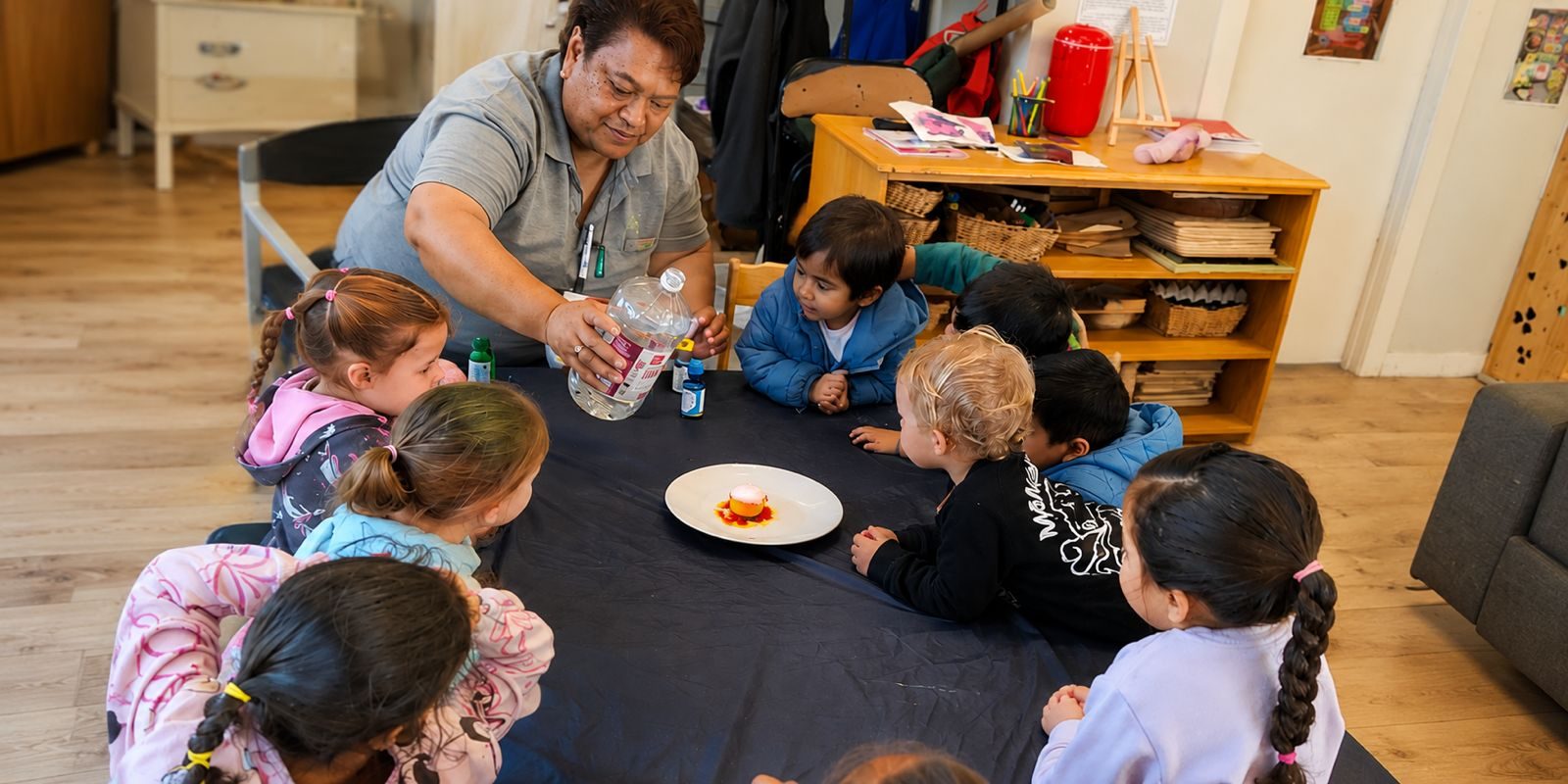
There is a particular kind of magic in watching a child discover something for the very first time. Recently at Nature’s Point, our tamariki became little scientists for the day, and the wonder on their faces said it all.
Science Day was all about hands-on exploration. With plates, colour, and a few simple ingredients, our curious learners watched fizzing, bubbling reactions unfold right in front of them. There were wide eyes, thoughtful questions, and plenty of “look what happened!” moments as they leaned in to see the colours swirl and the bubbles rise.
Learning through play, the way it should be
At Nature’s Point we believe children learn best by doing. Science Day was a perfect example. Rather than being told how something works, our tamariki got to test it for themselves, pouring, mixing, watching, and wondering.
That hands-on, play-based approach does more than fill a fun morning. When children make their own discoveries, they build confidence in their ideas, practise critical thinking as they ask “why” and “what if”, and develop the kind of natural curiosity that stays with them for life. These are the early foundations of a lifelong love of learning, and they grow best when children are given the space to explore freely.
Our kaiako sit alongside our tamariki through it all, asking gentle questions, following their lead, and helping them make sense of what they are seeing. It is learning that feels like play, because for young children, that is exactly what good learning looks like.
Science and nature go hand in hand
Science Day fits naturally into our nature-inspired curriculum. Every bush walk to Kirk’s Bush, every puddle investigated and leaf collected, is science in action. Children are observing, predicting, and experimenting all the time when they are outdoors. Days like this simply bring that same spirit of discovery inside, giving our tamariki another way to explore the world around them.
Try a little science at home
If your child came home buzzing about their experiments, here are a few simple activities Papakura whānau can try at home. All you need is a few things from the kitchen.
- Fizzing colours. Pop a little baking soda on a plate, add a drop or two of food colouring, then let your child spoon over some vinegar and watch it bubble and fizz. Simple, safe, and endlessly repeatable.
- Colour mixing. Give your child three cups of water coloured red, yellow, and blue, plus a few empty cups. Let them mix and discover how new colours appear. Expect a few surprises.
- Sink or float. Fill a tub or the sink with water and gather a handful of small objects. Ask your child to guess whether each one will sink or float before they test it. A lovely way to build early predicting skills.
The best part is not getting the “right” answer. It is the questions, the guesses, and the joy of finding out.
Come and see learning in action
We loved every moment of Science Day, and we cannot wait for our next adventure. If you would like to see how curiosity, nature, and play come together at Nature’s Point, we would love to show you around.
Book a free tour and meet the team here in Papakura.
Frequently Asked Questions
What kind of science activities do children do at daycare?
At Nature’s Point in Papakura, tamariki explore simple, safe, hands-on experiments like fizzing colour reactions, colour mixing, and sink-or-float play. These build curiosity, confidence, and early critical thinking through play.
Why is hands-on science good for young children?
Hands-on science lets children make their own discoveries, which builds confidence, problem-solving, and a lifelong love of learning far more effectively than being told how something works.
What is an easy science experiment to try at home with a toddler?
A simple favourite is fizzing colours. Put baking soda on a plate, add a drop of food colouring, then let your child spoon over vinegar and watch it bubble. It is safe, easy, and endlessly repeatable.